
The Best Detailing Brushes of 2026
DetailCompare is reader-supported. When you buy through links on this page, we may earn an affiliate commission at no extra cost to you. Prices noted were accurate as of August 2026 — click through for current pricing.
A wash mitt reaches maybe seventy percent of a car. The rest — wheel barrels, lug recesses, tire sidewalls, badge edges, vent louvers, the trench where the windshield meets the dash — needs a brush, and it needs the right one. Brushes are the category most people underspend on and then quietly blame their chemicals for.
They are also the category where the wrong choice does permanent damage. A stiff nylon brush belongs nowhere near piano black trim; an ultra-soft interior brush will never move bonded brake dust. This guide splits the work into the jobs that actually exist and names the best brush for each.
Our Top Picks
- Best overall: Speed Master Wheel Brush
- Best barrel brush set: Wheel Woolies 3-Piece Kit
- Best value barrel brush: EZ Detail Big Wheel Brush
- Best for interiors & delicate trim: Detail Factory Ultra-Soft Set
- Best tire brush: Mothers Contoured Tire Brush
Comparison
| Brush | Price | Bristle | Best for |
|---|---|---|---|
| Speed Master Wheel Brush | $20–50 | Memory foam | Wheel faces, engine bays |
| Wheel Woolies 3-Piece | $50–100 | Synthetic wool | Barrels, delicate finishes |
| EZ Detail Big Brush | $20–50 | Nylon | Barrels, caked brake dust |
| Detail Factory Ultra-Soft | $20–50 | Ultra-soft synthetic | Screens, gloss trim, badges |
| Mothers Contoured Tire | Under $20 | Stiff synthetic | Tire sidewalls only |
The Best Detailing Brushes in Detail
Speed Master Wheel Brush

Wheel brushes are quietly disposable: they work beautifully for a month, then the bristles take a permanent set — splayed on one side, curled on the other — and start pushing brake dust around instead of lifting it. The Speed Master is built specifically to not do that. Its patented memory bristles deform under pressure and then return to their original shape; rinse in hot water, hang it head-down, and the head resets like new.
It is soft enough for chrome, polished, and gloss black faces — there is no metal anywhere in the tool — while still being dense enough to shear grime off rather than glide over it. That balance is what most brushes miss in one direction or the other, and it is why this is the brush we hand people first. It quietly takes over your engine bay, wheel wells, and fuel door too.
- Memory bristles keep their shape for years
- Safe on chrome, polished, and matte finishes
- Chemical-resistant to acid-free cleaners
- Doubles as an engine bay brush
- Too short for deep truck barrels
- Costs more than generic wheel brushes
Wheel Woolies 3-Piece Brush Kit

Wheel Woolies are the barrel brushes professional detailers reach for, to the point that competitors describe their own products as “woolie-style.” The kit covers three lengths — 18-inch for barrels, 8-inch for faces and exhaust tips, and a genuinely clever 12-inch angled caliper brush whose bend slips between spoke and caliper where a straight brush simply will not fit.
The reason to pay the premium is structural. Most long barrel brushes are a bottle brush: bristles twisted around a steel wire core, then coated in plastic — and that coating is the only thing between steel and your wheel. Woolies use a flexible polypropylene core with plush synthetic wool bonded over it. There is no wire to expose, ever. On forged or powder-coated wheels, that guarantee is the product.
- Fully metal-free — no wire to expose
- Three lengths cover barrel, spoke, and caliper
- Plush wool carries enormous suds
- Built for years of professional use
- The most expensive set here
- Plush heads need diligent rinsing
EZ Detail Big Wheel Brush (18 in)
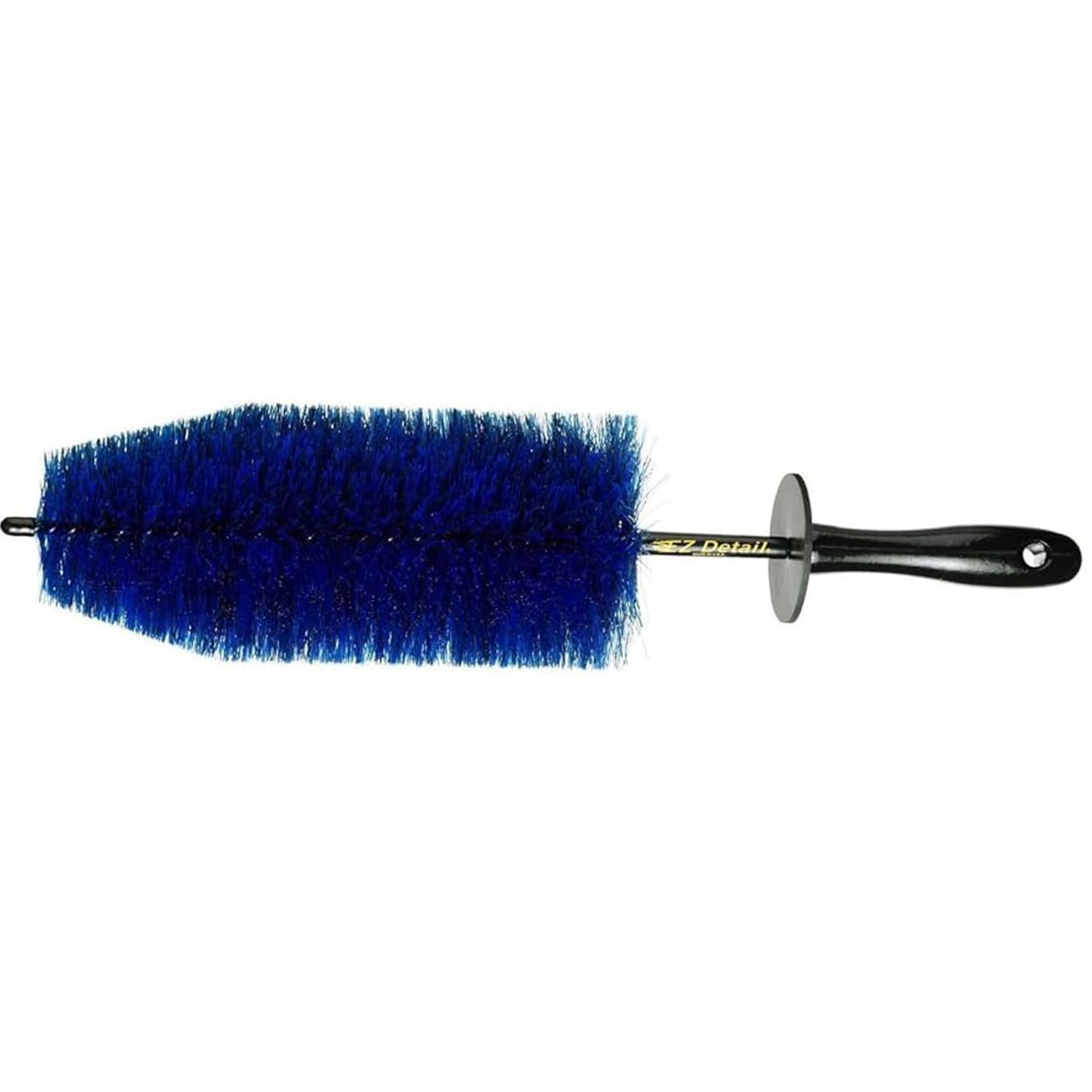
Wheel barrels are not cylinders — they are curved, stepped, obstructed shapes with a caliper in the middle. A rigid brush reaches the first two inches and gives up. The EZ Detail Big Brush is eighteen inches of nylon on a coated wire stem that bends under hand pressure and holds the curve, so you feed it through a spoke gap, aim it at the barrel wall, and sweep the full circumference.
Nylon is the trade-off worth understanding. It is stiffer than synthetic wool, so it shears bonded deposits that plush brushes smear, and it rinses clean in seconds rather than needing a proper flush. It is also more aggressive — keep the wheel wet and let the chemicals work. Inspect the coated tip occasionally and retire the brush if bare metal ever shows.
- Bends to match any barrel geometry
- Cuts caked deposits plush brushes smear
- Half the cost of a woolie set
- Also handles wells, grilles, and exhaust tips
- Stiffer than wool on delicate finishes
- Wire core is a long-term wear item
Detail Factory Ultra-Soft Detailing Brush Set

Modern interiors are a minefield of surfaces that scratch if you breathe on them: piano black consoles, glossy trim inserts, gauge clusters under clear plastic, infotainment screens. A hardware-store paintbrush with a metal ferrule ruins all of them — that ferrule is the single most common cause of interior scratches, and there isn’t one here.
The bristles are ultra-soft synthetic filament, fine enough to sweep dust from a vent louver without loading enough pressure to mar gloss plastic, and the handle is chemically resistant enough to survive a soak in all-purpose cleaner. Dry, they are dusting tools for vents, seams, and screen bezels. Damp, they agitate grime out of textured plastic and stitching that a towel only smears around. Outside, they are the right tool for badges, emblems, and grille slats.
- Safe on screens and piano black trim
- Metal-free ferrule cannot mar surfaces
- Resists interior cleaners and APCs
- Two sizes cover vents and wider panels
- Far too soft for wheels or engine bays
- Light bristles discolor over time
Mothers Contoured Tire Brush

Most bad tire shine results are not the tire shine’s fault. Dressing goes blotchy because it is applied over layers of old silicone, and sidewalls turn brown because antiozonant compounds bloom to the surface and never get scrubbed off. Both problems need real mechanical agitation on rubber, and no soft wheel brush can deliver it.
The contour is not marketing: a sidewall is convex, so a flat brush touches it along one line and wastes most of its bristles. This head curves to match, and the bristles are the stiffest in this lineup. Scrub with a rubber cleaner until the suds stay white — on a neglected tire that takes three rounds — and dressing applied afterward goes on evenly and lasts noticeably longer. The rubberized bumper means a slip bounces off rubber, not your wheel.
- Stiff enough to strip old dressing
- Contour matches the sidewall
- Rubber bumper protects the wheel
- Non-slip grip with wet hands
- Tire duty only — never on paint
- Short handle means kneeling at each corner
Detailing Brush Buying Guide
Think in jobs, not in brushes. There are four distinct jobs and no brush does more than two of them well: wheel faces and engine bays (soft, dense), wheel barrels (long, flexible), tire sidewalls (short, stiff), and delicate interior and exterior trim (ultra-soft, metal-free). Buy one brush per job you actually do. Most people need three: a face brush, a barrel brush, and a tire brush.
Bristle stiffness is the entire spec. Everything else — handle, color, branding — is secondary. Stiffness must go down as the surface gets more delicate and more visible. Barrel interiors nobody inspects tolerate nylon; a gloss black console tolerates almost nothing. When in doubt, go softer and let chemistry and dwell time do the work a stiffer brush would have done mechanically.
Metal-free is not a marketing word. Wire cores and metal ferrules are the two things in a brush capable of leaving a scratch you cannot polish out. Any brush touching a wheel face, paint, or interior trim should have neither. Long barrel brushes with coated wire cores are acceptable inside a barrel, where nobody looks — but check the coating periodically.
Chemistry beats scrubbing. A brush is there to remove what the chemical has already loosened. Let an iron-dissolving wheel cleaner dwell for two to four minutes before touching anything and the mechanical work drops to almost nothing — which is also how brushes and wheel finishes both survive longest. Our wheel cleaner guide covers the chemistry side.
How you store them decides how long they last. Rinse until the water runs clear, then hang the brush or stand it on its handle. A brush stored resting on its head splays permanently within months — the single most common way a good brush dies before its time.
Cleaning up after winter? For salt and mud on carpet and mats, a brush works best paired with the right cleaner. Our guide to cleaning winter mud, salt and odors from your car’s interior covers the products and steps.
Frequently Asked Questions
How many detailing brushes do I actually need?
Three covers almost everyone: a soft face brush for wheels and engine bays, a long brush for barrels, and a stiff brush for tires. Add an ultra-soft interior pair if your car has piano black trim or you detail the cabin properly.
Can I use one brush for wheels and paint?
No. Wheel brushes pick up embedded brake dust particles that stay in the bristles and act like sandpaper on clear coat. Keep wheel tools permanently separate from paint tools — colour-coding handles is the standard shop habit.
Are boar's hair brushes better than synthetic?
Not any more. Natural boar's hair is soft and holds water well, but it rots, retains odour, and degrades in modern alkaline cleaners. Current ultra-soft synthetics match the softness and survive the chemicals, which is why most professional lines have switched.
Can I just use a drill brush instead?
Drill brushes are excellent on tires, floor mats, and wheel wells — surfaces where speed matters and finish does not. Keep them off wheel faces and paint entirely: the combination of stiff nylon and hundreds of RPM removes clear coat, not just dirt.
How do I clean the brushes themselves?
Flush the head under running water until it runs clear, work a little car soap or APC through it if it has been in heavy brake dust, rinse again, then hang to dry. Plush wool heads need the most attention — grit left inside a woolie is grit dragged across the next wheel.
The Verdict
Start with the Speed Master — it is the brush that handles the most jobs safely and the one you will reach for weekly. Add the EZ Detail Big Brush for barrels and the Mothers Contoured for tires and you have every exterior job covered for well under a hundred dollars. Upgrade the barrel brush to the Wheel Woolies kit when your wheels justify it, and add the Detail Factory pair the first time you look closely at your vents. Browse the full lineup on our brushes and applicators page.